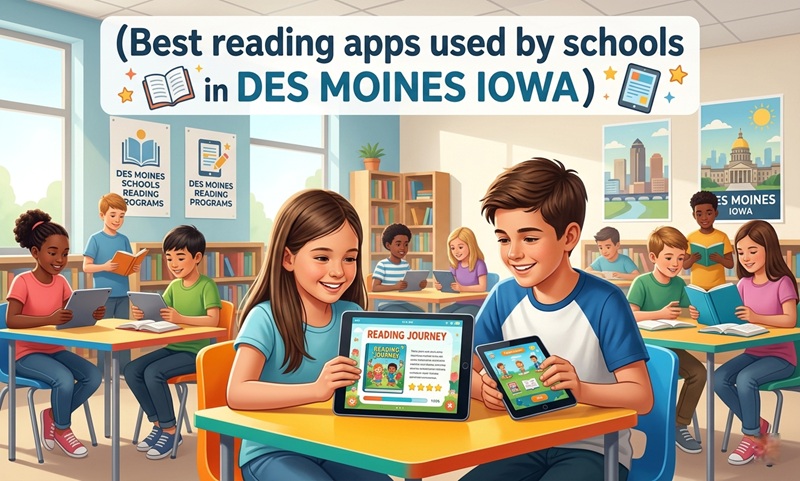
If your child is in the Des Moines Public Schools (DMPS) system, chances are they’re already using some of these reading apps in class — but a lot of families don’t know which ones or how to access them at home to reinforce what’s being taught. That gap between school and home practice is where reading development often slows down.
Here’s a practical look at the best reading apps currently used by schools in Des Moines, Iowa, and how families can use them to support their kids outside the classroom.
Why Reading App Selection Matters in Des Moines Schools
Des Moines Public Schools has made literacy a district-wide priority, particularly for early elementary students. Iowa’s reading legislation has pushed districts toward evidence-based reading instruction, which means schools are increasingly choosing apps and platforms backed by structured literacy research — phonics, phonemic awareness, fluency, and vocabulary instruction — rather than general reading game apps with no proven outcomes.
The apps schools choose reflect this shift. Many on this list are not household names, but they’re in classrooms because they work.
Best Reading Apps Used in Des Moines, Iowa Schools
1. Lexia Core5 Reading
Lexia Core5 is one of the most widely deployed reading intervention and enrichment apps in Iowa schools, including DMPS. It’s built on structured literacy principles — the same research base as the “Science of Reading” approach that Iowa has increasingly mandated.
What it does: Adaptive instruction covering phonemic awareness, phonics, fluency, vocabulary, and comprehension. The program adjusts difficulty in real time based on student performance.
Grade level: Pre-K through 5th grade
Home use: If your child’s school uses Lexia, students typically have login credentials to use it at home
Best for: Students below grade level and those needing structured phonics reinforcement
2. Amplify Reading (Formerly mCLASS)
Amplify Reading is widely used in Iowa for both assessment and instruction. DMPS uses mCLASS-based assessment for early literacy benchmarking, and the connected Amplify Reading platform provides game-based practice that reinforces assessed skills.
What it does: Adventure-style game format that teaches decoding, sight words, and reading comprehension
Grade level: Kindergarten through 3rd grade
Why schools choose it: Assessment-to-instruction pipeline — teachers see data and students practice targeted skills simultaneously
Home use: Accessible with school credentials
3. Seesaw
Seesaw is used widely across Des Moines elementary schools as a learning portfolio and communication tool, and many teachers build reading assignments directly into it. Students record themselves reading aloud, complete reading response activities, and communicate with teachers through the platform.
What it does: Multi-purpose learning tool; relevant for reading through reading logs, response activities, and oral reading recordings
Grade level: K–5 primarily
Home use: Yes — parents have direct access to a linked family account
Best for: Connecting home and school reading habits; parents can see and respond to their child’s work
4. Epic! (Getepic.com)
Epic is the digital library used by many Des Moines classrooms. Teachers assign books, and students have access to thousands of titles across levels. Epic uses AI-powered read-along features and leveled text to encourage independent reading practice.
What it does: Digital book access across genres and levels; read-aloud support; quizzes and engagement tools
Grade level: K–8
Cost for families: Free for students during school hours with teacher assignment; $9.99/month for unlimited home access
Best for: Building independent reading habits; increasing reading volume
5. Reading Eggs / Reading Eggspress
Reading Eggs (for younger readers) and its companion Eggspress (for older elementary students) are used by some DMPS schools as supplemental phonics and reading comprehension practice. The game-based format engages reluctant readers particularly well.
Grade level: Ages 2–13
Cost: School licenses vary; family subscriptions around $79–$99/year
Best for: Phonics-based early reading; engaging kids who resist traditional practice
6. Raz-Kids (Learning A-Z)
Raz-Kids is a leveled reader platform used in many Iowa classrooms for independent reading at precise Lexile levels. Teachers assign books, students read and record themselves, and the platform sends data back to teachers.
What it does: Leveled books, comprehension quizzes, read-aloud recording
Grade level: K–5
Home use: Yes, with teacher-assigned login
Best for: Building fluency and comprehension at appropriate reading level
Des Moines School Reading App Comparison
| App | Grade Range | School Use | Home Access | Free for Students? |
|---|---|---|---|---|
| Lexia Core5 | PreK–5 | Widespread | Yes (school login) | Yes (school license) |
| Amplify Reading | K–3 | DMPS assessment | Yes (school login) | Yes (school license) |
| Seesaw | K–5 | Communication + assignments | Yes (family app) | Yes |
| Epic! | K–8 | Digital library | Paid home plan | During school hours only |
| Reading Eggs | Ages 2–13 | Some DMPS schools | Paid family plan | School hours only |
| Raz-Kids | K–5 | Leveled reading | Yes (school login) | Yes (school license) |
Expert Insight: How to Use School Reading Apps at Home Effectively
The biggest mistake families make is treating these apps as TV time. Reading apps work best when they’re used consistently (20–30 minutes daily) and followed by a short conversation: “What happened in the book?” or “What word was hardest for you today?” That conversation activates comprehension in a way passive app use doesn’t.
For struggling readers especially, Lexia Core5 at home — even two sessions per week beyond school use — can meaningfully accelerate phonics development when combined with classroom instruction.
Pro Tips for Des Moines Families
- Check your child’s backpack or email for login credentials. Most DMPS reading apps come with a username and password sent home at the start of the year — often lost or forgotten.
- Call your child’s teacher. Ask which reading apps they use most in class and which ones students can access at home. Teachers appreciate the engagement.
- Prioritize the apps already assigned over purchasing new ones. Using Lexia or Raz-Kids more deeply is almost always more effective than adding a new consumer app.
Common Mistakes to Avoid
- Choosing an app based on entertainment value over evidence. Many popular kids’ apps have no structured literacy research behind them. Stick with what schools use.
- Letting kids rush through app sessions. Faster isn’t better. Reading apps work when students engage thoughtfully, not when they click through as fast as possible.
- Skipping the reading aloud component. Apps like Raz-Kids that let students record themselves reading are particularly effective — don’t let kids skip this feature.
FAQs
Q: What reading apps do Des Moines Public Schools use?
DMPS uses several platforms including Lexia Core5, Amplify Reading (mCLASS-based), Seesaw, Epic!, and Raz-Kids across its elementary schools. Specific usage varies by school and grade.
Q: Can my child use school reading apps at home in Des Moines?
Yes — most school-licensed reading apps, including Lexia Core5 and Raz-Kids, are accessible at home using the student’s school login credentials.
Q: Is Epic! free for students in Des Moines?
Epic is free during school hours when accessed through teacher assignments. A family subscription for unlimited home access is $9.99/month.
Q: What is the best reading app for struggling readers in early elementary?
Lexia Core5 is consistently the strongest evidence-based choice for students below grade level, particularly for phonics and decoding skill development.
Conclusion
The best reading apps for Des Moines students are already in the classroom — the key is extending that practice to home. Start by finding out which apps your child already has school access to (Lexia Core5, Raz-Kids, Seesaw, and Epic are the most common DMPS options), log them in at home, and establish a consistent 20–30 minute reading routine. The science is clear that reading volume and practice frequency drive literacy growth — these tools make it practical to build that habit outside school hours.