
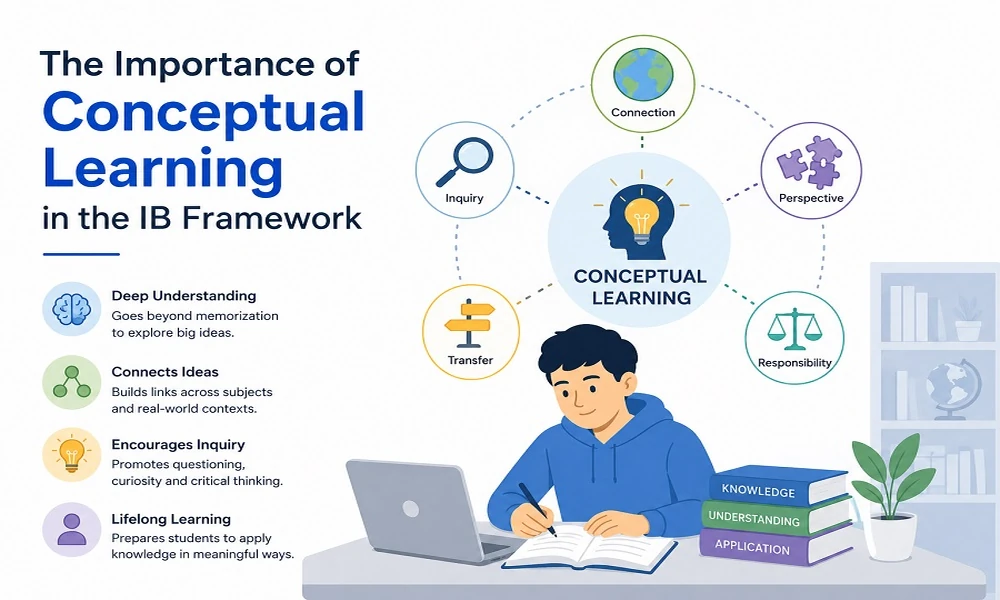
Education today extends beyond memorizing facts and figures. It is about helping students understand ideas, make meaningful connections, and apply their knowledge in real-world situations. This shift toward deeper understanding is one of the key reasons why conceptual learning has become an essential aspect of modern education. Within the International Baccalaureate (IB) framework, conceptual learning plays a central role in developing curious, reflective, and lifelong learners.
Many parents exploring International baccalaureate schools are drawn to the framework’s emphasis on understanding concepts rather than relying solely on rote learning. This approach encourages students to think critically, ask questions, and explore the relationships between different subjects. By focusing on broader ideas and themes, learners gain a deeper understanding of the world around them and become better prepared for future academic and professional challenges.
Conceptual learning is built around the idea that knowledge is interconnected. Instead of treating subjects as isolated disciplines, students are encouraged to identify patterns, draw comparisons, and understand how concepts apply across various contexts. For example, a concept such as sustainability can be explored through science, geography, economics, and social studies. This integrated approach helps students develop a more comprehensive perspective and enhances their ability to transfer knowledge from one situation to another.
One of the most significant benefits of conceptual learning is the development of critical thinking skills. Students are encouraged to analyze information, evaluate evidence, and form their own conclusions. Rather than simply recalling facts for examinations, they learn how to solve problems and make informed decisions. These skills are increasingly valuable in a rapidly changing world where adaptability and innovation are highly sought after.
Another advantage of conceptual learning is its ability to foster curiosity and engagement. When students understand the purpose behind what they are learning, they become more motivated to explore topics in greater depth. The learning process becomes more meaningful because students can relate concepts to their own experiences and interests. This sense of relevance often leads to improved participation, stronger retention of knowledge, and a genuine passion for learning.
The IB framework also places a strong emphasis on inquiry-based learning, which naturally complements conceptual understanding. Students are encouraged to ask questions, conduct research, and investigate real-world issues. This active involvement in the learning process helps them become independent thinkers and confident learners. Through inquiry, students gain a deeper appreciation of complex topics and learn how to approach challenges from multiple perspectives.
In addition, conceptual learning supports the development of global awareness and intercultural understanding. Students are encouraged to consider diverse viewpoints and explore issues that affect communities around the world. This broader perspective helps them develop empathy, respect, and a sense of responsibility toward others. As a result, they are better equipped to thrive in an increasingly interconnected global society.
Schools that embrace conceptual learning often create classroom environments where collaboration and discussion are encouraged. Students work together to share ideas, challenge assumptions, and build understanding collectively. Such experiences strengthen communication skills, teamwork, and confidence, all of which are essential for success in higher education and future careers.
Assessment within the IB framework also reflects the principles of conceptual learning. Students are evaluated not only on what they know but also on how effectively they can apply their understanding in different contexts. This encourages deeper learning and helps students develop skills that extend beyond academic achievement.
In conclusion, conceptual learning is a cornerstone of the IB framework because it promotes deeper understanding, critical thinking, and lifelong curiosity. By helping students connect ideas, apply knowledge, and engage with real-world challenges, this approach prepares them for success in an evolving world. As a result, International baccalaureate schools continue to be valued for nurturing confident, adaptable, and globally minded learners who are ready to make meaningful contributions to society.